Old Time Scouting Games Played At Brownsea Island
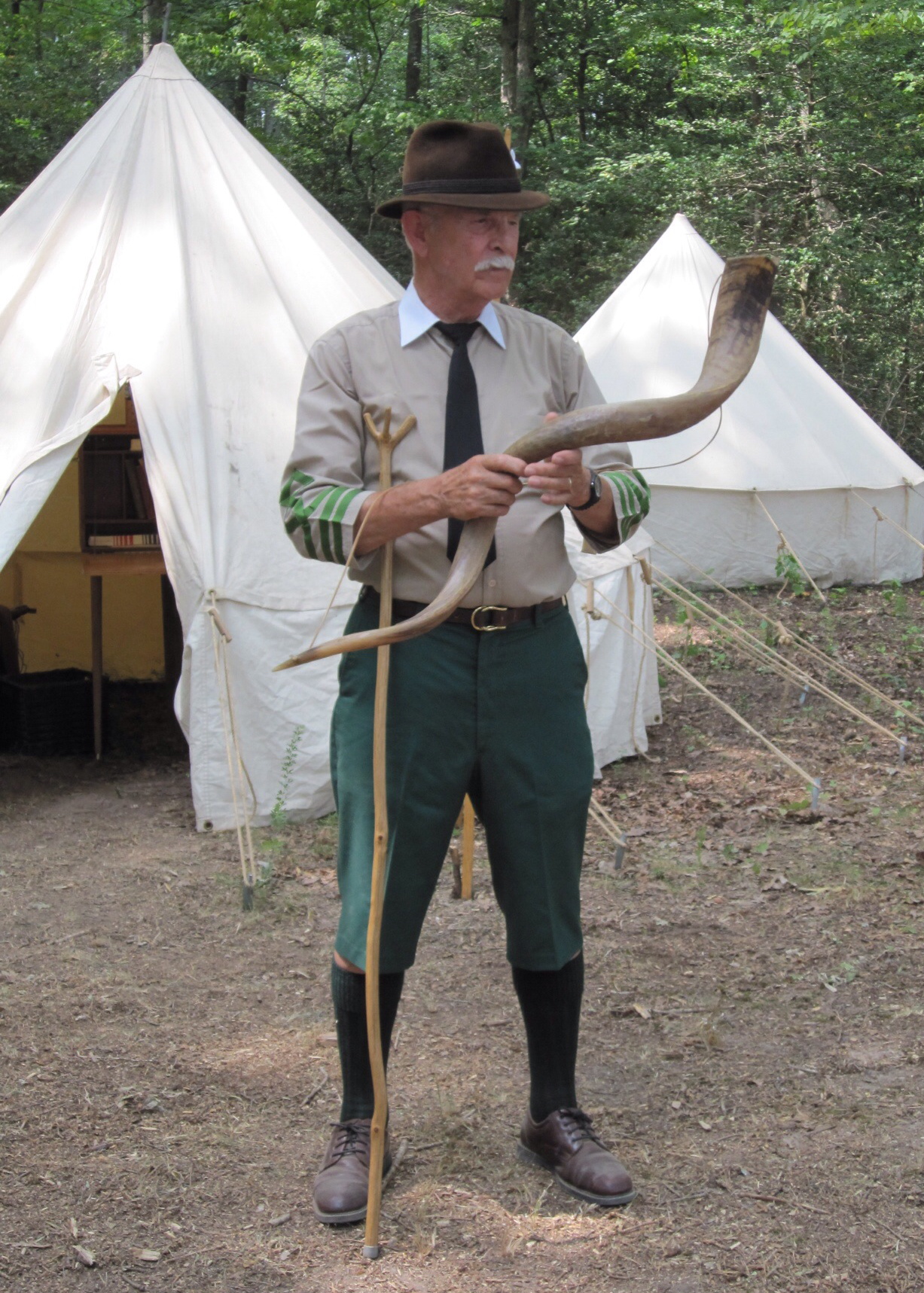
Here’s a guest post featuring four great rediscovered games for Scouts from Enoch Heise. Enoch’s blog Scouting Rediscovered should be on your reading list. Enoch has loads of enthusiasm and practical information on getting to the heart of Scouting from the perspective of a young (18 years old) Eagle Scout. Listen to a discussion with Enoch on Podcast 136.
Brownsea Island (archaically known as Branksea) is the largest of eight islands in Poole Harbour, on the south coast of Dorset.The island is owned by the National Trust with the northern half managed by the Dorset Wildlife Trust. Much of the island is open to the public (see opening dates/times below) and includes areas of woodland and heath with a wide variety of wildlife, together with cliff.
Like you I am always looking for something new to add to the program but the best new ideas almost always turn out to be old ideas!
Sometimes, Meetings and Troop activities can get stuck in a rut, and this vital, 2-hour opportunity for fun and growth can be wasted. Top 5 alternatives to fission for mac torrent. The solution to this is to keep the program varied and interesting with all kinds of Patrol Games and inter-Patrol competitions.
Too often, though, our creativity fails us and we find it hard to come up with a good selection of these games and activities. Fortunately, we have the benefit of 100 years of Scouting history full of all kinds of great games. These traditional Scout games are just as fun for Scouts today as they were decades ago. Sometimes they raise skill levels; sometimes they give great physical exercise; sometimes they’re just a lot of fun!
I’ve included the details of four of my favorite ones here in this post!
Wounded Prisoners
The great thing about Scout games is that they can be used to help Scouts improve in certain important skills. Instead of dryly drilling Scouts in a rank requirement, it can be turned into a game with a little preparation and creativity.
First Aid requirements are an excellent example of this. On the surface, First Aid requirements can be some of the most boring that Scouts have to learn. However, they are also some of the most important. Download ultraman zero the revenge of belial sub indo. Our history is full of examples where a Scout’s training has saved the life of an injured person. By turning First Aid practice into a game, Scouts can have fun while getting more proficient than they ever would otherwise. Baden-Powell gave us one such First Aid game in “Scouting For Boys” called ‘Wounded Prisoners’. Here is how it goes:
“Placed at various points, each fifty yards from camp, are prisoners: one for each competitor in the game. These prisoners have a tag, describing an injury, attached to their shirts. At a signal each of the competitors has to make for a prisoner, give him first aid for his injury and bring him home. The one who reaches camp first with a prisoner properly cared for, wins.”
This is a very simple game, but if done right, it can be very exciting. You can also adapt it to many different circumstances. It can be held during a meeting instead of just at camp. Two or three Scouts could be sent instead of just one for each ‘injured’ person. You can make it so Scouts have to traverse different obstacles and types of terrain.
Depending on how you set it up, each rescue team can either already have the required materials to do the job or they can be required to improvise. For instance, a broken leg can be splinted with a tree branch and some Scout neckerchiefs, and a stretcher can be fashioned from a couple of Scout staffs and sweaters or jackets. Leaders, or preferably older Scouts, should be the umpires and decide whether the competitors properly cared for the victim.
Whirling Jackstay
Games don’t always have to relate to a specific rank requirement, of course. Some games are great to do just for fun! They can keep things moving during Scout Meetings (Scout meetings should never stagnate by sticking to one thing too long!). They can burn off excess energy, and by creating a controlled period for ‘skylarking’, it’s a lot more fun and Scout-like than letting things devolve into chaos.
One game that I have found to be very popular with Scouts in my Troop is an old one called the “Whirling Jackstay”. I first tried this one out during a special Patrol Meeting while I was a Patrol Leader. Since then, it has spread to the rest of the Troop. This one came from a 1958 English Scout Book called “Patrol Meeting Blueprints” by John Sweet which gave ideas for Patrol Meetings in an illustrated format. Here is a copy of the game:
Depending on how fast the center man is twirling the rope, this game can be more or less challenging. I weighted the rope with a tightly bound bunch of cloth. Depending on how heavy the weight is, the game can get a little rough. I remember with some amusement the many times a Scout’s feet were caught mid-jump which sent him tumbling heavily to the ground. Nevertheless, this game has become a firm favorite for meetings.
The Blind Spider
Here is another great ‘just-for-fun’ game you can try with the Patrols in your Troop. It is called “The Blind Spider”. Here it is as described by John Sweet in another Patrol book he wrote called “Patrol Activities”:
“Blind Spider: A good game for the Troop-room where an overhead beam is available. Each Scout has a knotting-rope, one end of which is made fast to the beam. One Scout is blindfold and becomes the “Spider”. The object is for the Spider to catch as many “flies” as possible by touching them. Everyone, including the Spider, must keep hold of his own rope. When caught, the flies drop out.
This is quite a subtle game. The whole secret, of course, lies in the cunning way in which the spider entangles his own rope with the others, while the flies skip nimbly to and fro to dodge him – and in so doing get their ropes hopelessly entangled.”
Here is a helpful illustration from “Patrol Meeting Blueprints”:
This is really quite an ingenious variation of ‘tag’. All it requires is an overhead beam or tree branch, a blindfold, and a series of rope lengths.
This game should be kept fast-paced. For an averaged-sized Patrol with each member getting a chance to be the ‘spider’, it should only take about 10-15 minutes a round.
Thimble Finding
In the past, the skill of observation was much more heavily emphasized in Scouting than it is now. This is unfortunate, because observation is just as useful (if not more so!) today. Baden-Powell gave many observation games in “Scouting for Boys”. One of these is “Thimble Finding”. It is a very simple game which can be played indoors during a meeting. Here is how it goes:
“Send the Patrol out of the room. Take a thimble, ring, coin, bit of paper, or any small article, and place it where it is perfectly visible, but in a spot where it is not likely to be noticed. Let the Patrol come in and look for it. When one of the Scout sees it, he should go and quietly sit down without indicating to the others where it is. After a fair time he should be told to point it out to those who have not succeeded in finding it.”
This game puts a different twist on a simple “find the object” game. Not only can Scouts discover the object by simply looking for it, they can also get clues by observing the other Scouts.
This game also has limitless possibilities for variations. Multiple items can be used; the items can be put in more or less discrete locations; and different rooms can be used.
This is just one of many observation games which should be brought back into use by modern Scout Troops. I say “should” because training in observation is something that is vitally important in Scouting. So many people go through life today in their own world without being aware of what is going on around them. So many accidents could be prevented, so much good could be done, if more people practiced and got into the habit of good observation.
I hope you enjoyed reading about these historical Scout games. Try them out in your own Troop! The traditional Scouting program that the Scouts of the past practiced offers many solutions for the same difficulties we face in modern Scouting. Scout Meetings boring? Lackluster rank advancement? Chaotic ‘goofing off’ during meetings? Try some traditional Scout games! Get creative! Teach the Scouts in leadership about good planning, and challenge them to make each Scout Meeting better than the last one!
You can find John Sweet’s Patrol Meeting Blueprints in PDF format here (courtesy of the Dump)
Revised January 2019Requirements for the Scouting Heritage merit badge:
- Discuss with your counselor the life and times of Lord Baden-Powell of Gilwell. Explain why he felt a program like Scouting would be good for the young men of his day. Include in your discussion how Scouting was introduced in the United States, and the origins of Boy Scouting and Cub Scouting under Baden-Powell.
- Do the following:
- Give a short biographical summary of any TWO of the following, and tell of their roles in how Scouting developed and grew in the United States prior to 1940.
- Daniel Carter Beard
- William D. Boyce
- Waite Phillips
- Ernest Thompson Seton
- James E. West
- Discuss the significance to Scouting of any TWO of the following:
- Brownsea Island
- The First World Scout Jamboree
- Boy Scout Handbook
- Boys' Life magazine
- Give a short biographical summary of any TWO of the following, and tell of their roles in how Scouting developed and grew in the United States prior to 1940.
- Discuss with your counselor how Scouting's programs have developed over time and been adapted to fit different age groups and interests (Cub Scouting, Boy Scouting, Exploring, Venturing).
- Do ONE of the following:
- Attend either a BSA national jamboree, OR world Scout jamboree, OR a national BSA high-adventure base. While there, keep a journal documenting your day-to-day experiences. Upon your return, report to your counselor what you did, saw, and learned. You may include photos, brochures, and other documents in your report.
- Write or visit the National Scouting Museum. Obtain information about this facility. Give a short report on what you think the role of this museum is in the Scouting program.
- Visit an exhibit of Scouting memorabilia or a local museum with a Scouting history gallery, or (with your parent's permission and counselor's approval) visit with someone in your council who is recognized as a dedicated Scouting historian or memorabilia collector. Learn what you can about the history of Boy Scouting. Give a short report to your counselor on what you saw and learned.
- Learn about the history of your unit or Scouting in your area. Interview at least two people (one from the past and one from the present) associated with your troop. These individuals could be adult unit leaders, Scouts, troop committee members, or representatives of your troop's chartered organization. Find out when your unit was originally chartered. Create a report of your findings on the history of your troop, and present it to your patrol or troop or at a court of honor, and then add it to the troop's library. This presentation could be in the form of an oral/written report, an exhibit, a scrapbook, or a computer presentation such as a slide show.
- Make a collection of some of your personal patches and other Scouting memorabilia. With their permission, you may include items borrowed from family members or friends who have been in Scouting in the past, or you may include photographs of these items. Show this collection to your counselor, and share what you have learned about items in the collection. (There is no requirement regarding how large or small this collection must be.)
- Reproduce the equipment for an old-time Scouting game such as those played at Brownsea Island. You may find one on your own (with your counselor's approval), or pick one from the Scouting Heritage merit badge pamphlet. Teach and play the game with other Scouts.
- Interview at least three people (different from those you interviewed for requirement 5) over the age of 40 who were Scouts. Find out about their Scouting experiences. Ask about the impact that Scouting has had on their lives. Share what you learned with your counselor.
Scouting Heritage Worksheet